Agentic AI Strategy
Why agentic AI needs a nervous system, not just a brain
Enterprise AI deployments are fast, often accurate, and genuinely useful. They are also, in any meaningful operational sense, opaque. This series is about closing that gap.
Why agentic AI needs a nervous system, not just a brain
Post 1 of 6 in the Agent Intelligence Fabric series. My opening teaser used a travel app experience to frame the journey intelligence problem. This series builds the argument from there.
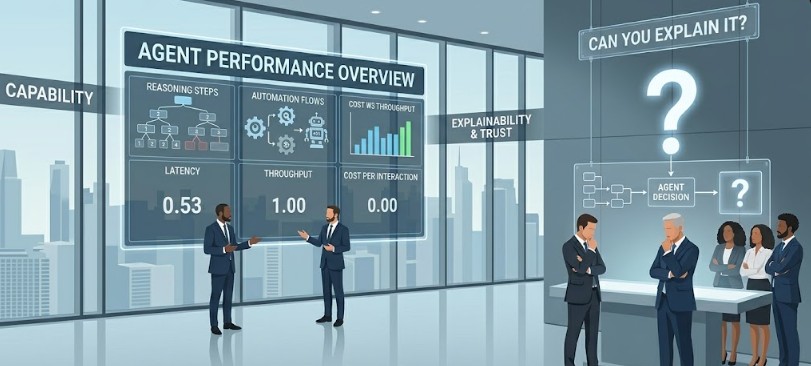
The capability gap everyone is talking about — and the accountability gap nobody is
If you spend time in enterprise AI conversations today, the discussion is almost entirely about capability. What can agents do? How many steps can they reason across? Which workflows can be automated? What’s the latency? What’s the cost per interaction?
These are legitimate questions. The capability progress is real, and the business case for agentic AI deployment is increasingly well-evidenced.
But there’s a second set of questions that surfaces far less often — and that I believe will define which organisations build durable AI advantage versus those that accumulate expensive liability:
When an AI agent makes a decision, can you explain it?
Not in general terms. Not “our model is trained on customer data and uses retrieval-augmented generation.” Specifically: for this decision, about this customer, at this moment — what did the agent know, what did it conclude, what did it do, and how do you know that was the right thing?
Most enterprise AI deployments today cannot answer that question. The agents are fast, often accurate, and genuinely useful. They are also, in any meaningful operational sense, opaque.
This post begins a six-part series on closing that opacity gap — on building what I’m calling the Agent Intelligence Fabric.

The travel app story, restated
In my opening post, I described a modern travel app experience where a delayed flight updated downstream experiences automatically, gate changes triggered contextual notifications, and support interactions already knew what had happened earlier in the journey.
What made that experience feel intelligent was not any single AI capability. It was the system’s ability to reason across connected journey signals — to maintain context across time, channels, and events, and to use that context to make each subsequent interaction more relevant.
I argued that journey awareness becomes critical infrastructure as enterprises move toward agentic AI. An agent without journey context can automate tasks. An agent that understands where the customer is, what they’ve experienced, what friction they’ve encountered, and what their intent is evolving toward — that agent can make genuinely intelligent decisions.
But the travel app story has a second dimension I didn’t address in the teaser.
Behind those seamless experiences is an enormous amount of operational infrastructure: data pipelines that are reliable, event streams that are complete, decision logic that is testable, and — critically — observability that lets the teams running these systems understand what is happening and why.
The intelligence is visible to customers. The infrastructure that makes it trustworthy is not. And in enterprise AI deployments, that invisible infrastructure is where the real work is.
What “deploying agents at scale” actually means
Enterprises deploying agentic AI today are typically running multiple agent types across multiple channels — customer support agents, network operations agents, billing dispute agents, retention agents, fraud detection agents. Each is optimised for its specific workflow. Each is, in most architectures, operating with limited visibility into what the others are doing.
This is the structural context problem at scale. Not one agent missing context — a fleet of agents, each seeing a slice of the customer and the operation, none of them seeing the whole.
The consequences play out in predictable ways:
A support agent resolves a technical query efficiently — but has no visibility into the billing dispute the customer raised two days earlier, or the retention offer they received last week that they found patronising. The resolution is technically correct. The experience compounds frustration.
A retention agent fires an upsell offer — but has no context that the customer is mid-complaint, that their NPS score last quarter was 3, or that they’ve already spoken to three different agents this month. The offer is algorithmically targeted. The timing is tone-deaf.
A network operations agent executes an automated remediation — but produces no traceable record of what diagnostic signals triggered the decision, what configuration change it made, or what the outcome was. When a related incident surfaces 48 hours later, the investigation starts from zero.
These are not edge cases. They are structural patterns in any agentic deployment that lacks a shared observability layer.
The accountability gap
The context problem produces poor experiences. The accountability gap produces liability.
Consider what happens when a customer escalates a complaint about an AI-driven decision — a credit denial, a service interruption, a billing adjustment. The organisation needs to answer specific questions:
- What information did the agent have at the point of decision?
- What reasoning process did it follow?
- What policy or constraint governed its action?
- Was there a human in the loop, and at what point?
- What was the measurable outcome?
In most current deployments, these questions are unanswerable with any precision. You can retrieve logs. You cannot reconstruct reasoning. You have outcomes. You cannot attribute them to specific decisions.
This accountability gap is not just a compliance risk — though regulatory frameworks like the EU AI Act are making it one. It is an operational risk. It means you cannot learn systematically from agent failures, cannot continuously improve agent behaviour, and cannot make credible investment cases for expanding AI programmes based on measured outcomes rather than anecdote.
The Agent Intelligence Fabric
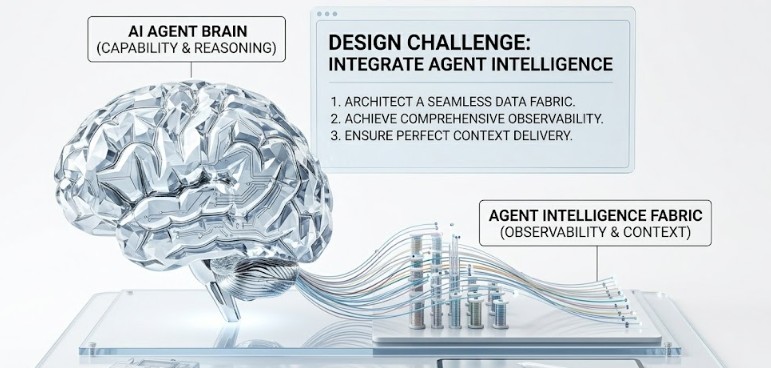
The Agent Intelligence Fabric is the observability, audit, and governance layer that sits beneath agentic AI systems and addresses both the context problem and the accountability gap.
I use the word “fabric” deliberately. This is not a single system or a monitoring dashboard. It is a set of interconnected capabilities — data capture, reasoning trace storage, decision logging, outcome attribution, policy enforcement, and audit infrastructure — that together make AI agents observable, measurable, and governable.
Think of it as the nervous system for your agentic AI programme. The agents are the brain — the reasoning, decision-making capability. The Fabric is the nervous system that connects those decisions to context, to outcomes, to oversight, and to continuous improvement.
Without the nervous system, the brain can act. It cannot learn reliably, cannot be held accountable, and cannot be trusted at the scale enterprises need.
What this series covers
Over the next five posts, I’ll work through the Agent Intelligence Fabric in detail:
Post 2 — The anatomy: the four observability layers every agent deployment needs, what each captures, and who in the organisation needs it.
Post 3 — Where the returns are: the four enterprise domains where agentic AI is producing real ROI, the specific risk profiles in each, and what the Fabric must do to capture the upside safely.
Post 4 — Build vs. buy: the real TCO of agent observability infrastructure, vendor landscape realities, and the staged approach that avoids the most common failure modes.
Post 5 — The governance layer: policy enforcement, human-in-the-loop design, and what EU AI Act readiness actually requires from an engineering standpoint.
Post 6 — What responsible AI leadership looks like: closing synthesis, organisational patterns, and the accountability question every leader should be asking before the next agent goes live.
My perspective throughout is that of a practitioner — someone who has worked at the intersection of customer journey data, experience intelligence, and enterprise AI for several years. I have watched organisations invest heavily in AI capability while systematically underinvesting in AI accountability. This series is an attempt to make the case for rebalancing that investment — and to provide a practical framework for doing so.
The fundamentals matter. Build them before you scale.
Next: Post 2 — The anatomy of Agent Intelligence Fabric: the four observability layers, what they capture, and why most teams only build one.